 |
| Blue skies and sunshine on Remembrance Sunday in South Somerset. |
Sunday, 11 November 2018
Wonderful autumn sunshine on Remembrance Sunday in South Somerset.
Blue skies and autumn sunshine on Remembrance Sunday in South Somerset
.

Tuesday, 6 November 2018
Field-Marshal Lord Harding of Petherton. Commemorated at Taunton Castle's Museum of Somerset.
A few weeks
ago while wandering around the centre of Taunton I came across the Museum of
Somerset in Taunton Castle. Tucked away
in the entrance courtyard is a modest bust commemorating Field-Marshal Lord
Harding of Petherton, someone I had vaguely heard of due to his connection with
the Somerset Light Infantry, but other than that I knew little about him. I decided to do some research.
 |
| The commemorative bust of Lord Harding of Petherton in the courtyard of Taunton Castle's Museum of Somerset. |
Allan
Francis Harding was born at Rock House in South Petherton, Somerset, on 10th February 1896. His father Francis Ebenezer Harding was a
clerk to a local firm of solicitors and his mother was Elizabeth Ellen Harding (nee
Anstice). Both parents came from large
families - Francis was one of eight children and Elizabeth Anstice one of
thirteen. The Hardings and the Anstices
were descended from yeoman farmers and tradesmen who had lived in and around
South Petherton for hundreds of years.
 |
| The plaque on the wall of Rock House. |
 |
Rock House in South Petherton, South Somerset, birthplace of Field-Marshal Lord Harding.
|
At the age
of 10 Harding went to Ilminster Grammar School, leaving at the age of 15 to
work as a boy clerk at the Post Office Savings Bank in London. Many of his colleagues were in the
Territorial Army and they encouraged him to join them. Harding applied for a commission and became a
Second-Lieutenant in the 1/11 Battalion of the London Regiment, a battalion of
the 2nd (London) Territorial Division, in May 1914.
After the
outbreak of World War One Harding’s battalion became part of the 54th (East
Anglian) Division. In July 1915 it
embarked for Gallipoli to act as a reinforcing division. Harding first saw action on 15th August when he
was wounded in an attack on Turkish positions.
After the withdrawal from Gallipoli he remained in the Middle East,
participating in General Sir Edmund Allenby’s victorious campaign against the
Turks in Egypt and Palestine. He ended
the war in command of a battalion.
After the First World War Harding served in Britain and India. While home on leave from India in 1926 he
fulfilled a promise to visit a fellow officer’s mother who lived in the Somerset village
of Long Ashton near Bristol. There he
met her daughter Mary, the step-daughter of Charles Harrington Fry of the
famous chocolate manufacturing family, and married her the following year when
his battalion returned to England.
The autumn
of 1940 found Harding in the Middle East where he joined the staff of General Sir
Archibald Wavell and was involved in the planning and execution of Operation
Compass the offensive which led to General Richard O’Connor’s crushing victory
over the Italians in the Western Desert.
At the end
of March 1941 Field-Marshal Erwin Rommel launched a counter-attack with his
newly arrived German forces which led to the capture of several British
commanders including General O’Connor and his successor Lieutenant-General Philip
Neame. Harding took command, stabilized
the situation and, with the Australian Major-General L.J. Morshead, organized
the defence of Tobruk.
During
Operation Crusader, which ended in a victory over Rommel’s forces on Christmas
Eve 1941, Harding was Brigadier General Staff, to Lieutenant-General A.R.
Godwin-Austin commanding 13 Corps.
On 21st January 1942 Rommel counterattacked and by 6th February the British had lost all
the gains made by Crusader.
Godwin-Austin asked to be relieved of command as he had fallen out with
his superiors over tactics. Harding, who
admired and supported his commander, left 13 Corps to become Director of
Military Training at GHQ Cairo.
Harding
took command of the 7th Armoured Division on the 17th September 1942 in time
for the Second Battle of El Alamein.
Four months later, while in pursuit of Rommel’s forces on the road to
Tripoli, he was badly injured when a shell exploded in front of his command
tank as he stood atop it spotting for his artillery. His wounds were very serious and he was
evacuated back to England with his future on active service in doubt.
While
making a remarkable recovery, Harding bought a 130 acre farm with dilapidated
farmhouse near Nether Compton in Dorsetshire.
He and his wife and son moved in in time for Christmas 1943. So complete was his return to fitness that he
was offered the post of Chief of Staff to General Sir Harold Alexander
commander of the 15th Army Group, sometimes known as Allied Armies in
Italy. On New Year’s Day 1944 he flew
from an airfield in North Devonshire to take up his new post in the
Mediterranean. Harding served on
Alexander’s staff until March 6th 1945 when he was given command of 13 Corps,
and was in that post when the fighting in Italy ended.
During his
time in Italy Harding was knighted by King George VI. He chose to be known as Sir John Harding,
John being the name he had used throughout his time in the Army.
After the
Second World War Harding’s appointments included, Commander-in-Chief Far East, Command of the British army of the Rhine, Chief of the Imperial General Staff
from 1952 to 1955, and Governor of Cyprus 1955 to 1957. In November 1953 he had been made Field-Marshal.
On
retirement he accepted several directorships including that of Plesseys, the
telecommunications equipment manufacturer, of which he became chairman in
1967. He was also the first chairman of
the Horserace Betting Levy Board.
Lord
Harding died at his home in Nether Compton on 20th January 1989.
Sources:
Harding, John (Allan Francis) first Baron
Harding of Petherton. (ODNB) https://doi.org/10.1093/ref:odnb/40129
Harding of Petherton, Field-Marshal, Michael Carver (Weidenfeld and
Nicolson, London, 1978).
Dilemmas of the Desert War, Michael Carver (B.T. Batsford Ltd,
1986).
Sunday, 28 October 2018
Touching Remembrance tribute at Tatworth in South Somerset.
Earlier this month, driving along the A358 in South Somerset,
I passed the village of Tatworth where I saw standing beside a hedgerow a
touching Remembrance tribute in the form of two figures, a soldier and a nurse, dressed in the style of the First World War.
Nearby, also beside the A358, is the imposing Church of St.
John the Evangelist. In its churchyard is
a traditional war memorial commemorating Tatworth’s fallen of two world
wars. Twenty-eight names are inscribed
for World War One together with the words: “IN MEMORY OF THE FALLEN / 1914-1918
/ THEY DIED FOR ENGLAND”. Five more
names are inscribed for World War Two.
 |
| Touching Remembrance tribute beside the A358 at Tatworth in South Somerset |
 |
| A Remembrance tribute seen at the South Somerset village of Tatworth. |
 |
| The war memorial in the churchyard of St. John the Evangelist at Tatworth in South Somerset. |
 |
| The Church of St. John the Evangelist stands beside the A358 at Tatworth in South Somerset. |
Thursday, 25 October 2018
Stogursey Castle, a picturesque Norman ruin in West Somerset.
I recently accompanied my wife to Stogursey, a village 8 miles from Bridgwater in West Somerset, where she was visiting a very good friend from her days at university. It was a very bright and clear autumn day so
after a pleasant lunch I decided, with camera at hand, to stroll down to the
remains of Stogursey Castle.
The village and castle take their name from the manor of
Stoke which in 1086 was in the possession of William de Falaise. Williams’s daughter Emma married William de
Courcy, the couple received the manor of Stoke upon their wedding and renamed
it Stoke Courcy. The manor became known
as Stogursey which is how the village and castle received their names.
The castle dates from the time of William the Conqueror, but
was besieged, overthrown and destroyed between 1455 and 1457 during The Wars of
The Roses.
 |
| The ruined walls of Stogursey Castle in West Somerset. |
From High Street signposts direct you to the castle along
the appropriately named Castle Street and public footpaths. It is not possible to enter the castle
grounds as The Landmark Trust operates the gatehouse cottage as a holiday
let. However, it is practicable to walk
around part of the outer bank of the moat.
 |
| The gatehouse cottage and moat of Stogursey Castle in West Somerset. |
 |
| The gatehouse cottage, which dates from the 17th century, at Stogursey Castle in West Somerset. |
To learn more about the history of Stogursey Castle and its gatehouse
cottage visit The Landmark Trust’s website where you will find a mine of
information.
https://www.landmarktrust.org.uk/search-and-book/properties/stogursey-castle-12342Tuesday, 23 October 2018
The loss of the minelayer HMS ABDIEL at Taranto. One of her officers is remembered at the Church of St.Michael and All Angels in the village of Rowberrow, Somerset.
South of Churchill on the A38 in Somerset is a narrow lane leading
to Rowberrow, one of those Mendip villages once involved in the mining of calamite. I first explored the lane around ten years
ago; this month I decided to have another look.
Just a few hundred yards from the
A38, holding fast to the top of a precipitous hill, is the parish church and
manor house. In the churchyard of the
Church of St. Michael and All Angels there is a war memorial in the form of a
cross with a bronze long sword attached to its west face. It commemorates the men of the Somerset Light
Infantry who died in the First World War and names Captain R.J.R. Leacroft, of
Rowberrow Manor, who was killed serving with the regiment on the first day of
the Battle of The Somme.
 |
| The war memorial in the churchyard at the Church of St. Michael and All Angels, Rowberrow in Somerset. |
Another name was added to the memorial after the Second World War,
that of Lieutenant Commander (E) Anthony Holland Brown who was killed on the 10
September 1943 while aboard the minelayer HMS ABDIEL. This year saw the 75th anniversary
of that warship’s loss in Taranto Harbour.
ABDIEL, completed in April 1941, was the first of a class of 6 minelayers. They were of 2,650 tons displacement with a
speed of almost 40 knots, a crew of 242, carried 156 mines and an armament of
4inch AA guns in 3 twin mountings. Due
to their very high speed the ships of the class were often used to run supplies
to the besieged island of Malta.
On September 10 1943 ABDIEL was sunk by mines in Taranto Harbour
while taking part in Operation Slapstick.
Because of a shortage of aircraft the plan involved Royal Navy ships
landing British troops of the First Airborne Division to capture the Italian
ports of Taranto and Brindisi. Only
hours after berthing in Taranto ABDIEL detonated two mines laid previously by
German torpedo boats as they evacuated the harbour. The ship, which sank in 3 minutes, was
carrying men from the 6th (Royal Welch) Parachute Battalion. The
Battalion suffered 58 men killed and 150 wounded while Lt. Cdr. Brown was among
the 48 of ABDIEL’S crew who were lost.
Operation Slapstick was ultimately successful as the First
Airborne Division captured the ports of Taranto and Brindisi in working order.
Lt. Cdr. (E) Anthony Holland Brown was 40 years old and the
husband of Jessie Elizabeth Brown B.A. (Cantab.) of Rowberrow, Somerset. He is remembered on the Plymouth Naval
Memorial as well as at the Church of St. Michael and All Angels.
 |
| The Church of St. Michael and All Angels, Rowberrow in Somerset. |
Sunday, 21 October 2018
Remembrance figures in Chard, South Somerset.
“Birthplace
of powered flight”, proclaim the signs on the main roads leading into South
Somerset’s ancient town of Chard.
Therefore it seems appropriate that to commemorate the end of the First
World War the figure of an airman stands at attention beside the A358 on the
southern fringe of the town.
 |
| Sponsored by Chard Town Council the figure of a First World War airman stands at attention. |
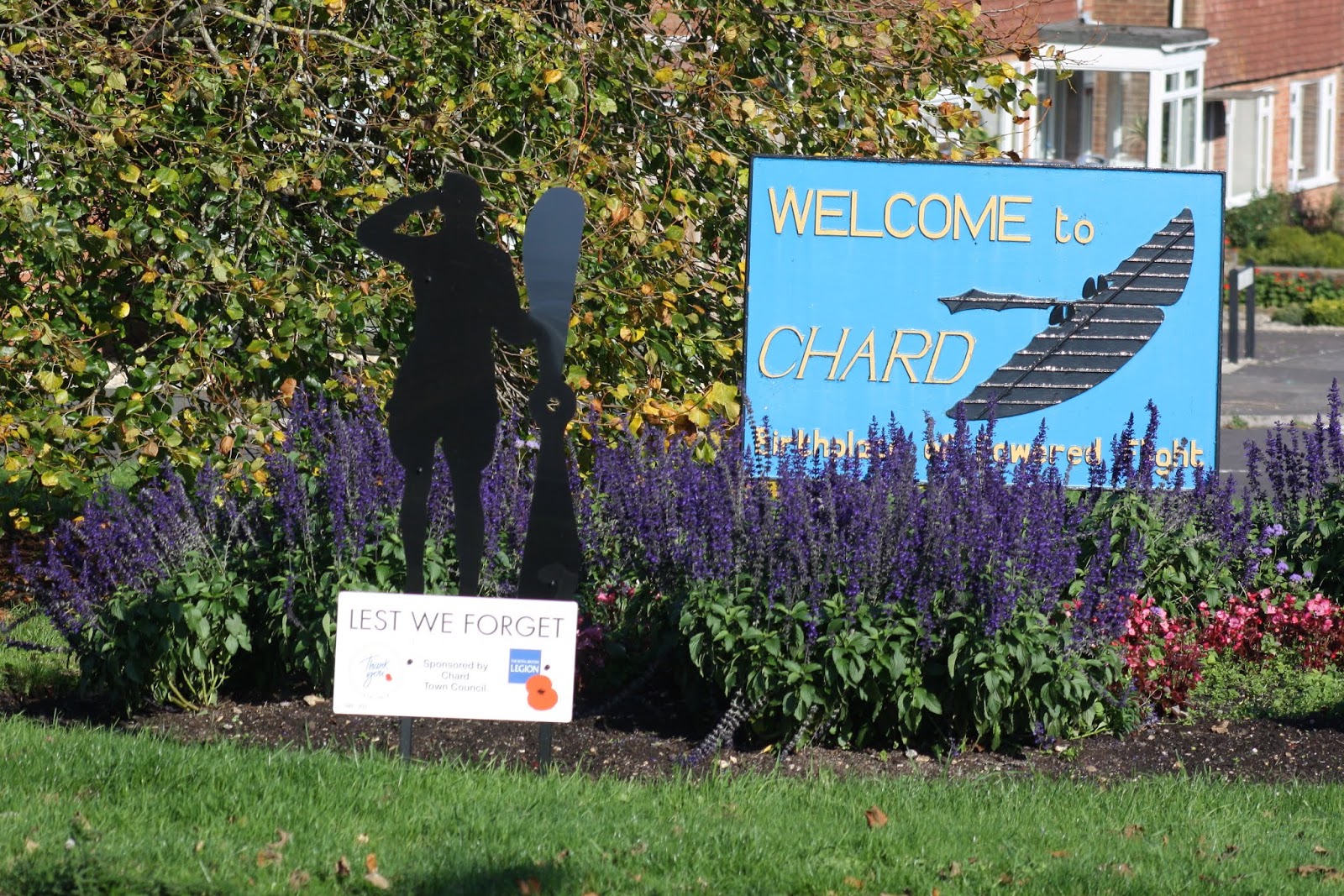 |
| Chard in South Somerset remembers those who died serving their country. |
Friday, 19 October 2018
Herne Hill in South Somerset on a foggy autumn morning.
There was thick fog in my part of South Somerset this morning. At around 11am the fog was lifting under a clear blue sky, and Herne Hill began to appear out of the murk.
 |
| Herne Hill in South Somerset appears out of the murk on a foggy autumn morning. |
Subscribe to:
Posts (Atom)